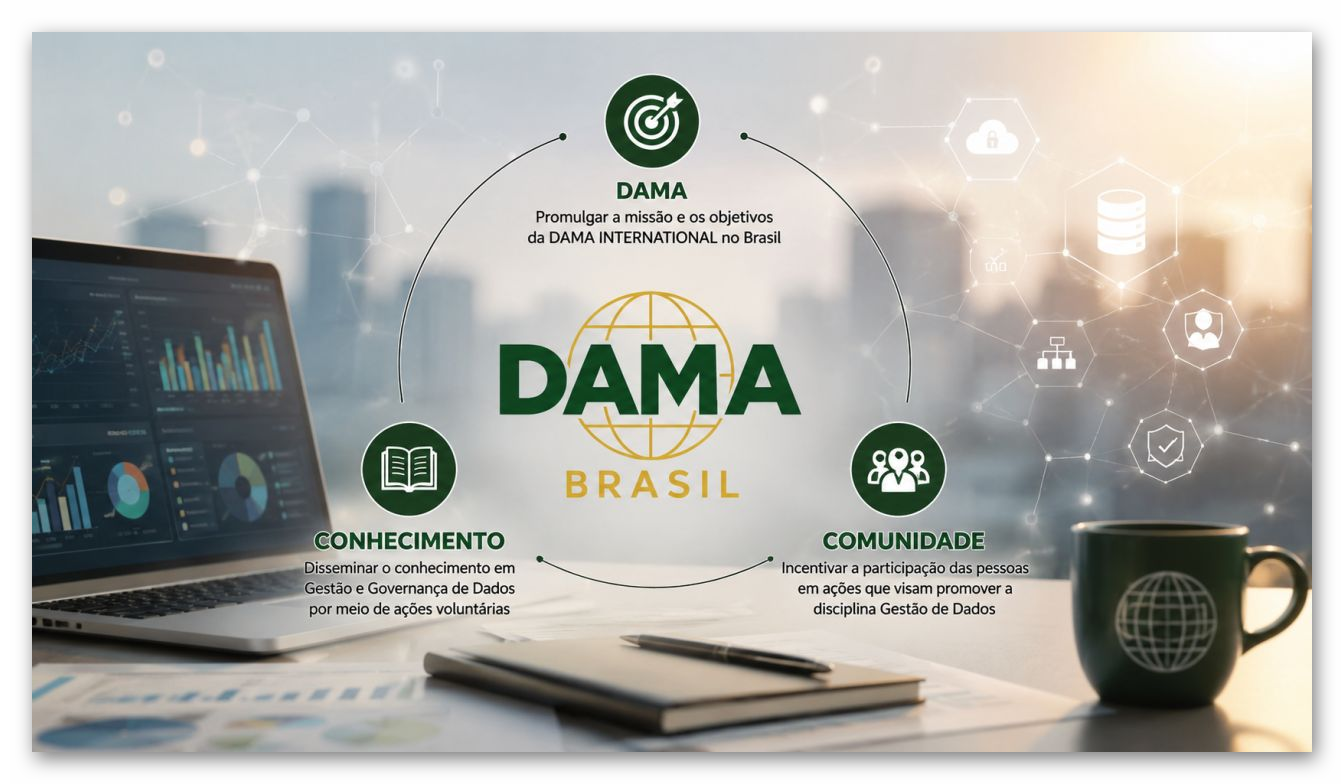
The first meeting of the new DAMA Brazil mandate, alongside the presidency team, took place a few days ago. On April 12, 2026, I was honored to be appointed Ethical Data & AI Governance Advisor to the Presidency, a position I will hold for the 2026-2028 biennium. I shared the news that day. What I did not share, as it is impossible to compress into a post, is what the position signifies once you enter operations, speak with those building the Brazilian chapter, and begin to understand how decisions are made.
This article provides space for that. For those following my trajectory in data governance, privacy, and AI, it answers a question that appears in various forms in conversations: what is DAMA in practice? What do its contributors actually do? And why does this matter for the Brazilian ecosystem?
<!-- Suggested INTERNAL LINK: once the article on "What DAMA represents" (Editorial Calendar Post 2) is published, create a cross-link here -->
What is DAMA International and DAMA Brazil
DAMA International, the Data Management Association International, is the global reference association for data management. Founded in 1988, it is present in over 40 countries through local chapters. It is not a certifying body, a school, or a consultancy. It is a professional association—DPOs, CDOs, data architects, data engineers, governance and privacy specialists—who convene to systematize, develop, and disseminate the area's best practices.
DAMA International publishes the DAMA-DMBOK, the Data Management Body of Knowledge, the framework that organizes data management disciplines and serves as the foundation for professional practice worldwide. This publication makes DAMA a global reference: it is not a brand, but a technical repository built by professionals, peer-reviewed by professionals, and applied by organizations across diverse sectors.
In Brazil, DAMA Brazil is the national chapter. It brings together data professionals from all sectors—finance, health, retail, industry, public sector—organizing working groups, events, and best practices adapted to the local reality. This adaptation necessarily includes the interface with the LGPD (General Data Protection Law) and the ongoing regulatory debate regarding artificial intelligence in Brazil.
The DAMA-DMBOK: The Body of Knowledge Organizing the Discipline
The DAMA-DMBOK, in its second edition, organizes data management into 11 knowledge areas: data governance, data architecture, data modeling and design, data storage and operations, data security, data integration and interoperability, document and content management, reference and master data, data warehousing and business intelligence, metadata management, and data quality.
Each area has defined processes, roles, activities, and deliverables. This structure has immediate practical consequences. When an organization claims it will "govern its data" but lacks clarity on which of these areas it is addressing, or how each connects to the others, the program fragments. The DAMA-DMBOK provides exactly this map: it is not a prescriptive method, but a shared vocabulary and systemic vision that allows DPOs, CDOs, legal experts, and executives to communicate using a common reference point.
Knowing DAMA from the outside is one thing. Entering the operation, talking to those building the Brazilian chapter, and understanding how decisions are made is another. It carries an institutional weight that is only perceived from within.
What the Role of Ethical Data & AI Governance Advisor to the Presidency Means in Practice
The position of Ethical Data & AI Governance Advisor to the Presidency of DAMA Brazil exists because data governance and artificial intelligence governance are increasingly inseparable—and because the ethical dimension of this conversation cannot be peripheral.
When an organization decides to implement an AI model to support decisions, it is simultaneously making choices regarding data governance (what data does the model use?), privacy (does this data include personal information? was it collected on a proper legal basis under LGPD?), architecture (is the model auditable? are its results traceable?), and ethics (are the results fair? do they discriminate against vulnerable groups?).
None of these questions can be answered in isolation. The ethical governance advisor's role exists to articulate these fields and contribute to the development of best practices, technical references, and debates that the Brazilian ecosystem needs to advance.
To this position, I bring over 30 years of experience in IT and governance, with background in highly regulated industries. I worked for over two decades in multinationals within the pharmaceutical sector—Sanofi, Merial, Boehringer Ingelheim, and Rhodia-Mérieux—where systems validation standards, internal controls, and data quality were requirements, not choices. Through this path, I gained clarity on what it means for governance to actually function, rather than just exist on paper.
I am the co-founder of Privacidade+, a certified DPO, and a Lead Auditor for ISO/IEC 27001, 27701, and 42001—the latter being the international standard for artificial intelligence management systems. I work at Keyrus on Data and AI Governance projects for medium and large organizations. What I have learned on this journey supports the position I have long advocated: governance is not control; it is a competitive advantage.
The Institutional Weight Only Perceived from Within
DAMA Brazil is a non-profit association. Everyone who contributes—from the presidency to the advisors and working groups—donates their time and knowledge. There is no remuneration. There is a purpose: to strengthen the Brazilian community of data professionals, raise the level of practices, and position Brazil as a protagonist in the global debate on data governance and AI.
In this 2026-2028 administration, the president is Sergio Silva. Alongside him, Gustavo Artese sits on the board. This is a leadership committed to real maturity, substantive debate, and an agenda the sector must face with more courage: data sovereignty, ethics in AI use, and the need to build national capacity in managing critical information.
At DAMA, no one leads alone. Everyone contributes. This associative model—voluntary, technical, committed to the good of the community—is part of what makes the institution solid. The credibility of the DAMA-DMBOK comes exactly from this: it is produced by professionals who have no commercial interest in the outcome, only a technical one.
Entering this operation and observing how decisions are made, with what level of care and what long-term horizon, is the type of realization that reinforces my commitment.
Data Governance is Competitive Advantage, Not Control
This is the position I have long defended, and one that my new responsibility at DAMA Brazil reinforces.
When an organization treats data as a strategic asset—with an updated inventory, measured quality, defined owners, and clear retention and disposal policies—it makes better decisions. This is because decisions stem from reliable information. It reduces exposure because it knows what it possesses, where it is, who accesses it, and for what purpose. It grows on firmer ground because it builds trust with clients, partners, regulators, and employees.
The counterpoint is real and documented in concrete cases: organizations that treat governance as a cost or a regulatory hurdle end up investing in AI based on data they do not understand, exposing themselves to unmapped risks, and responding to incidents that could have been prevented. Poorly governed data is not neutral; it amplifies bad decisions.
In the context of AI, this becomes even more critical. Machine learning models learn from the data they receive. If that data reflects biases, inconsistencies, or outdated information, the model will not correct them: it will encode them. Data governance is, therefore, a prerequisite for AI governance. Not the other way around.
The 6 principles of Trustworthy AI—accountable, fair, privacy-respecting, robust, explainable, and transparent—are not aspirations detached from operational reality. They are outcomes that depend directly on the quality of the data governance underpinning them.
What is Being Built and What Lies Ahead
In the coming months, I will document in this space what is being built by DAMA Brazil on the front I represent: the ongoing debates, the frameworks we are developing, and the issues that, in our view, the sector still needs to address with more courage.
Among the most urgent topics: the interface between LGPD and AI governance, the need for risk assessment frameworks adapted to the reality of Brazilian organizations, and the role of data sovereignty in the national technological development agenda.
DAMA Brazil does not operate in isolation on this agenda. It dialogues with the ANPD (National Data Protection Authority), the legislative debate surrounding Bill 2,338/2023 (the AI bill currently in the Brazilian legislature), private sector entities, and academia. Having an active and technically solid national chapter is part of Brazil's response to a question the entire world is trying to answer: how to govern artificial intelligence responsibly?
The answer starts with data. And it starts with governance.
Frequently Asked Questions about DAMA Brazil and Ethical Data Governance
What is DAMA International? DAMA International, shorthand for the Data Management Association International, is the premier global association for data management professionals. Founded in 1988 and present in over 40 countries, it is responsible for publishing the DAMA-DMBOK, the reference body of knowledge for the field, and for uniting data professionals from organizations across various sectors and countries.
What is the DAMA-DMBOK? The DAMA-DMBOK (Data Management Body of Knowledge) is the reference framework for data management published by DAMA International. It organizes the discipline into 11 knowledge areas—data governance, architecture, modeling, storage, security, integration, document management, master and reference data, business intelligence, metadata, and data quality—serving as the basis for governance programs in organizations worldwide.
What is DAMA Brazil? DAMA Brazil is the national chapter of DAMA International. It brings together Brazilian professionals working with data and governance, promoting working groups, events, and best practices adapted to the Brazilian context, including the interface with LGPD and the regulatory debate on artificial intelligence.
What does ethical data and AI governance mean? Ethical data and AI governance is the practice of managing data and artificial intelligence systems with responsibility, transparency, and respect for the rights of the individuals whose information is being processed. It involves legal compliance, such as LGPD and GDPR, but goes further: it includes fairness in the use of data in automated systems, privacy as a value embedded in system design, traceability of algorithmic decisions, and accountability for the impacts generated.
Why is data governance considered a competitive advantage? Organizations that govern their data well make decisions based on reliable information, reduce exposure to regulatory and operational risks, and build trust with customers and partners. In the context of AI, this advantage is amplified: models trained on well-governed data produce results that are more robust, auditable, and defensible before regulators and the public.
What is DAMA Brazil's role in the Brazilian data and AI ecosystem? DAMA Brazil contributes to raising the maturity of the Brazilian ecosystem in data management and governance. It promotes the adoption of best practices, trains professionals, and participates in the regulatory and technical debate regarding data and AI in the country. As a chapter of a global entity present in more than 40 countries, it connects Brazilian practices to international debates and architectural references in the field.
Being Part of it is a Choice to Contribute
Joining DAMA Brazil is not just a line on a resume. It is a choice to contribute in a concrete, voluntary, and technical manner. What is being built during this mandate matters to the Brazilian data and AI ecosystem, and this space will document part of that process.
Governing data ethically is not a distant aspiration. It is a practice that can be structured, measured, and taught. And that is exactly what DAMA Brazil, in dialogue with professionals, academia, and regulators, is committed to building in Brazil.
In future articles, I will delve deeper into the themes this position brings to light: data sovereignty, the ANPD agenda, what is still missing in Brazilian AI regulation, and what organizations should be doing now to avoid regrets later.
About the Author
Consuelo Rodrigues is an expert in data governance, data protection, privacy, and artificial intelligence governance. Co-founder of Privacidade+, she is a certified DPO and Lead Auditor for ISO/IEC 27001, 27701, and 42001 standards. She was appointed Ethical Data & AI Governance Advisor to the Presidency of DAMA Brazil for the 2026-2028 mandate. She works at Keyrus on Data and AI Governance projects for medium and large organizations. With over 30 years of IT experience, she has a background in highly regulated pharmaceutical multinationals and an MBA from Fundação Dom Cabral. She is a member of APDADOS, the National Association of Data Privacy Professionals.
Published on: [date of publication] Last updated: [date of update] Category: Data Governance | DAMA Brazil | Responsible AI Tags: DAMA Brazil, DAMA-DMBOK, data governance, AI governance, trustworthy AI, LGPD, data sovereignty, data protection, DPO, responsible AI