Artificial Intelligence has ceased to be merely a technical tool and has become a central infrastructure for our society and business. However, as we delegate more decisions to these systems, a critical question arises: how can we ensure we are not handing over our future to unpredictable "black boxes"?
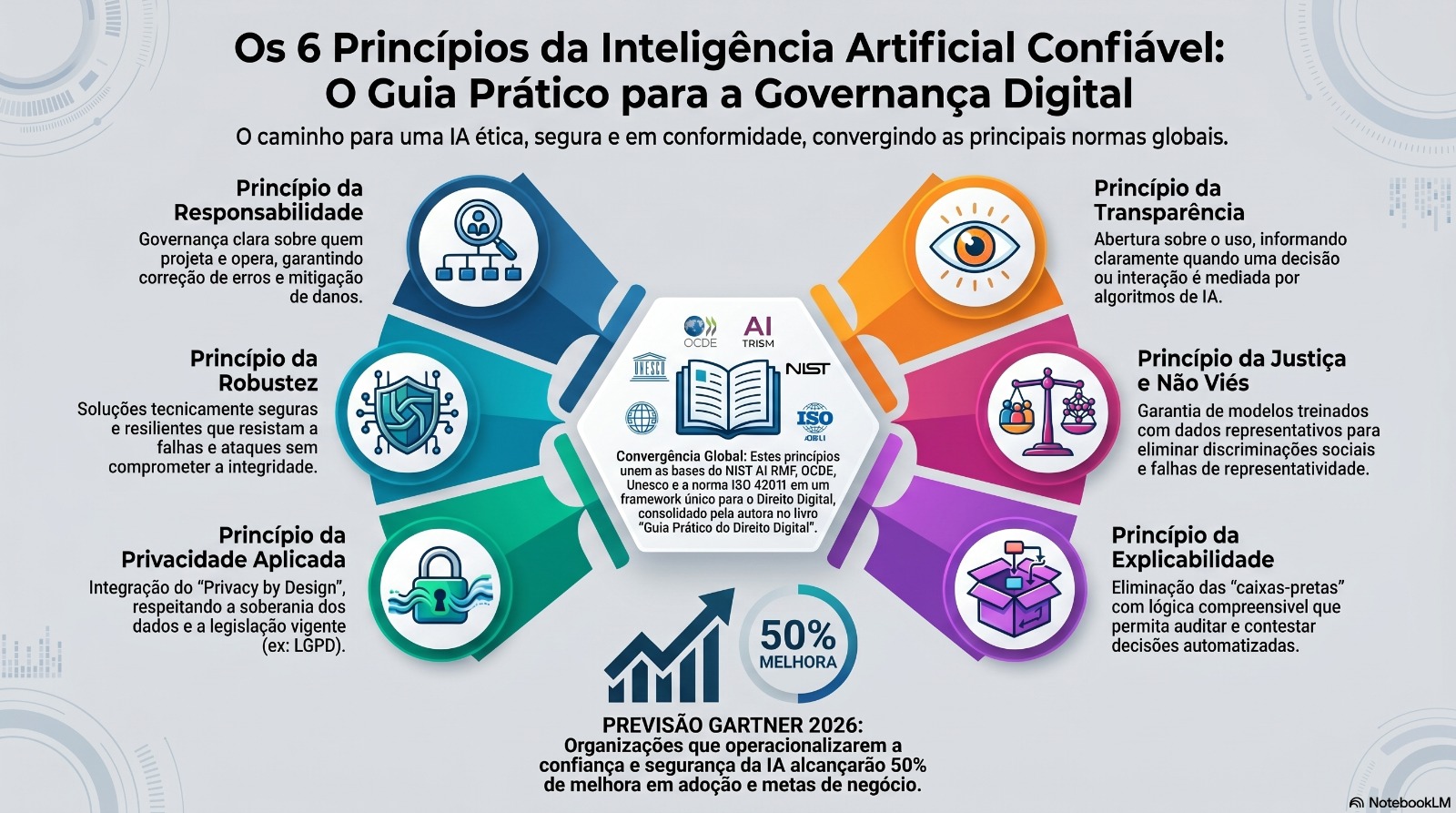
The answer lies in AI Governance and the construction of Trustworthy AI. As I structured in my book, drawing from global guidelines and recommendations from the OECD and UNESCO, and intersecting with market frameworks such as Gartner's AI TRiSM and NIST's AI RMF—alongside civilizational perspectives like the Pope's recent Magnifica Humanitas encyclical—we have reached six non-negotiable principles.
But what do they mean in practice?
1. Principle of Accountability: AI lacks moral consciousness and cannot answer for its actions. Responsibility must always remain human, clearly defined, and documented.
Practical example: A company establishes a Multidiscisplinary Governance Committee (including IT, legal, and compliance areas) to manage model operations (ModelOps) and ensure there is a human "chain" responsible for auditing, approving, or even deactivating the AI in case of anomalies.
2. Principle of Robustness: AI solutions must be technically secure, resilient, and capable of operating as expected under a variety of circumstances, even in the face of attacks.
Practical example: Protecting a corporate virtual assistant against adversarial attacks (such as prompt injection or model poisoning), ensuring it proactively resists and does not provide malicious outputs if tested to its limits by external agents.
3. Principle of Applied Privacy: Data protection must be integrated from the design phase (Privacy by Design), respecting protection legislation and ensuring individual privacy.
Practical example: When training an AI model with data from a CRM system, the team uses minimization or anonymization techniques to ensure that no Personally Identifiable Information (PII) of customers is inadvertently exposed, complying with regulations such as GDPR or LGPD.
4. Principle of Transparency: Users have the right to know what they are interacting with and how their data is being used. Transparency builds trust and is the foundation for accountability.
Practical example: Making it clear on a customer service platform that the consumer is talking to a chatbot, as well as documenting the provenance of the model's training data to prevent violations and misinformation.
5. Principle of Fairness and Non-Bias: Biased systems can amplify and perpetuate historical inequalities. AI must be fair, seeking to mitigate discrimination against groups or individuals.
Practical example: Proactively auditing a resume screening algorithm in HR or a bank credit granting system, ensuring it does not discriminate against minorities, genders, or races, and delivers impartial and equitable results.
6. Principle of Explainability: The end of "black-box" processing. We must understand the algorithmic logic behind an output. While transparency tells us "what" happened, explainability and interpretability tell us "how" and "why" the machine decided that way.
Practical example: The adoption of agnostic numerical explainability (XAI) tools, such as the SHAP or LIME libraries, in a medical diagnostic system. Thus, when the AI suggests a treatment, the physician can visualize exactly which variables and exams had the greatest impact on that machine prediction.
AI Governance is not a barrier to innovation; it is the guardrail that allows your company to innovate faster and sustainably.
The market has already understood this. According to Gartner, organizations that operationalize AI trust, risk, and security management (AI TRiSM) will achieve, by 2026, a 50% improvement in model adoption, business goals, and user acceptance.
The remaining question is: is your organization already treating AI as a civilizational and corporate security priority, or do you still trust the algorithm blindly?