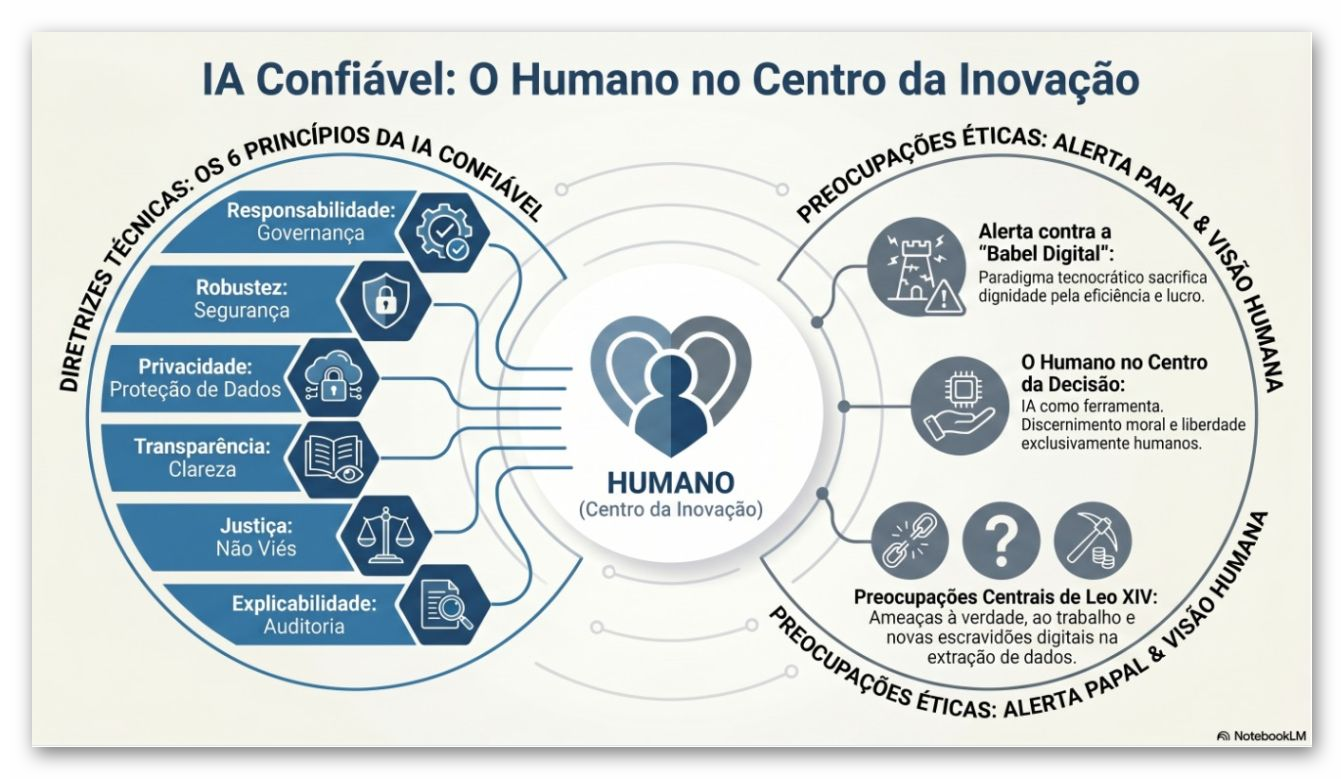
"Artificial intelligence is not neutral." This sentence opens the Magnifica Humanitas encyclical, signed by Pope Leo XIV on May 15, 2026, on the 135th anniversary of Rerum Novarum—Leo XIII's social encyclical that defined the Church's position regarding the Industrial Revolution. The continuity is no coincidence: Leo XIV chose his papal name precisely because he saw in this historical moment a parallel to what the Church faced at the end of the 19th century.
When I read the document, I performed a personal exercise. I crossed what the Pope writes with the six principles of Trustworthy AI that I systematize in one of the books I co-authored, based on sources such as the OECD and UNESCO. The convergence is striking. Not because one copies the other, but because we are, it seems, facing the same problem, viewed from completely different angles.
This article is the record of that exercise.
What is Magnifica Humanitas and why it is not a circumstantial religious text
Magnifica Humanitas, the literal translation of which is "Magnificent Humanity," is the first encyclical of Pope Leo XIV and was published on May 25, 2026. The five-chapter document was written with the support of scientists and researchers in the field, granting it a technical density uncommon for this type of document. It is not a pastoral reflection on abstract dangers of technology. It is an institutional positioning, with precise vocabulary, on how artificial intelligence challenges central categories of the Church's Social Doctrine: human dignity, the common good, solidarity, social justice.
The choice of date is not accidental. By signing the encyclical on the 135th anniversary of Rerum Novarum, Leo XIV draws a direct line between the challenge of the Industrial Revolution and the challenge of AI. In both moments, a technological transformation concentrated economic power and created new risks for workers, the governed, and those who do not control the instruments of production. Rerum Novarum responded to the labor issue. Magnifica Humanitas responds to the algorithmic issue.
The document places AI ethics at the center of Social Doctrine, not as a peripheral or circumstantial theme, but as a necessary development of values the Church has defended for centuries: the irreducibility of the human person, the centrality of responsibility, the refusal to instrumentalize the other.
The six principles of Trustworthy AI: What they are and where they come from
Before exploring the convergence with the encyclical, it is worth situating the technical framework I use for this exercise.
The six principles of Trustworthy AI that I systematize in the book I co-authored derive from global reference documents, particularly the OECD guidelines and the UNESCO Recommendation on the Ethics of AI, adopted by its 193 member states in 2021. They are:
Transparency: AI systems must be understandable to those affected by them. Responsibility: there must be a human subject who answers for the decisions the AI informs or executes. Fairness and non-bias: AI systems must not illegitimately discriminate against groups or individuals. Privacy: the processing of personal data in AI systems must respect fundamental rights. Explainability: the reasons why an AI system reached a specific result must be understandable and communicable. Robustness: AI systems must function reliably, safely, and resiliently, including against manipulation attempts.
These principles are not philosophical aspirations. They are operational criteria that underpin regulations such as the EU AI Act—the European regulation that classifies systems by risk level—and technical standards such as ISO/IEC 42001, the international standard for AI management systems.
What the Pope says and where the principles meet
Magnifica Humanitas uses three concepts that deserve direct attention from anyone working with AI governance.
The first is what the document calls the "architecture of visibility," a term used to denounce algorithmic opacity: the way AI systems organize what people see, hear, and believe, without this organization being transparent or auditable. It is the absence of transparency and explainability. It is exactly what the principles of Trustworthy AI seek to correct.
The second concept is "new colonial extractivism," with which the Pope describes the massive collection of data from populations that do not understand what is being collected, its purpose, and who benefits. It is the absence of privacy and justice. Data extracted from vulnerable communities, used to train models that serve interests other than their own.
The third point is the most incisive: the warning that delegating sensitive decisions to apparent mathematical objectivity hides human choices that must be audited. Algorithms are not neutral. They carry the choices of those who design them, fund them, and define their objectives. This is exactly the central thesis of responsibility as a principle: the chain of accountability cannot be broken by the presence of a machine in the process.
The convergence is not superficial. The Pope and the technical frameworks start from different premises and arrive at the same questions.
The hardest point: The dehumanization of decision-making and the subject of responsibility
The most difficult passage of the encyclical is where Leo XIV addresses AI in military contexts, stating that no algorithm can make war morally acceptable, and that any technology facilitating attacks without seeing the opponent's face lowers the moral threshold of conflict.
The argument is relevant far beyond the martial context. The Pope is articulating a principle: the dehumanization of lethal decision-making. And this principle applies to any decision that profoundly affects a person's life.
When an AI system decides whether an individual receives credit or not, it is making a decision with real consequences for that person's life. When a resume screening algorithm eliminates candidates before any human sees them, it is making a hiring decision. When a judicial decision support system weighs the probability of recidivism, it is participating in a decision that could restrict someone's freedom.
In all these cases, the risk is the same: we lose the subject of responsibility. If the machine decides and no one answers for it, the chain of accountability breaks. And without a responsible subject, there is no way to seek redress. There is no way to question. There is no way to correct. No justice is possible.
This is the core of the responsibility principle in Trustworthy AI: critical decisions must have a human who signs off on them. Not one who passively supervises, but one who assumes ownership. AI can inform, suggest, and calculate. The decision, when it involves fundamental rights, needs a first and last name.
The parallel with the Industrial Revolution and the risk of social pollution
The historical parallel I draw with the Industrial Revolution is direct: it enriched the few and left pollution for the many. It took decades to learn how to charge the polluter—decades of environmental regulation, social pressure, and litigation. When factory smoke began to kill, the concept of environmental externality had not yet been invented. The cost was real, but it wasn't on the bill of those generating it.
AI carries the risk of producing equivalent social pollution. Consumer markets emptying because people lose income when replaced by automated systems. Abysses of inequality between those who control technology and those controlled by it. Concentration of economic and cognitive power in a few global players.
Technology saves, improves, and is inexorable. No honest analysis denies this. But inexorability is not an argument against regulation. Electricity was also inexorable. The automobile was too. What is required is not the interruption of technological advancement, but the existence of guardrails that provide time for adaptation, distribute benefits more equitably, and ensure that those who generate social costs are held accountable.
This is where ethical AI governance moves from the corporate territory to the civilizational one. It is no longer just a matter of compliance or organizational regulatory adjustment. It is a question of how a society decides who is responsible for what machines do.
Moral influence and what it invokes
The Pope has the moral influence to call global attention to what is at stake. Magnifica Humanitas does this with precision and without technophobic romanticism. The document is not against AI. It is against AI without a subject, without responsibility, without accountability.
This is also the position I defend as a specialist in data and AI governance. Ethical AI governance is not an obstacle to technological development. It is the condition for that development to be sustainable—socially, economically, and humanly.
The convergence between the encyclical and the technical frameworks for Trustworthy AI is not an intellectual curiosity. It is a sign that the agenda is real, urgent, and broader than any single disciplinary field can encompass alone. When ethics arrive at the same point from such different places, it is worth stopping to pay attention.
Frequently Asked Questions about Magnifica Humanitas and Trustworthy AI
What is the Magnifica Humanitas encyclical? Magnifica Humanitas is the first encyclical of Pope Leo XIV, published on May 25, 2026, signed on May 15, on the 135th anniversary of Rerum Novarum. The five-chapter document addresses the safeguarding of the human person in the age of artificial intelligence and was written with the support of scientists and researchers. It places AI ethics at the center of the Church's Social Doctrine.
What are the six principles of Trustworthy AI? The six principles of Trustworthy AI are: transparency, responsibility, fairness and non-bias, privacy, explainability, and robustness. They derive from global reference documents, especially OECD guidelines and the UNESCO Recommendation on the Ethics of AI. These principles underpin regulations like the EU AI Act and technical standards like ISO/IEC 42001.
What does "architecture of visibility" mean in the encyclical? "Architecture of visibility" is the term used in Magnifica Humanitas to describe how AI systems organize what people see and hear without transparency or auditability. The concept denounces algorithmic opacity—the absence of transparency and explainability principles in systems that shape collective perceptions and decisions.
What is the "new colonial extractivism" mentioned by the Pope? "New colonial extractivism" is the expression used in the encyclical to describe the massive collection of data from populations that do not understand what is collected, for what purpose, and who benefits. The concept connects data extraction to historical practices of extracting natural resources from vulnerable communities without compensation or real consent.
Why is AI decision-making in critical contexts a responsibility problem? When AI systems make or inform critical decisions, such as credit granting, hiring, or judicial assessments, without a human assuming responsibility for the outcome, the chain of accountability is broken. Without an identifiable responsible subject, there is no way to demand reparation, question criteria, or correct errors. This is the central principle of responsibility in Trustworthy AI: decisions affecting fundamental rights must have a human signatory.
What is the relationship between the encyclical and technical AI governance frameworks? Magnifica Humanitas and technical frameworks for Trustworthy AI—derived from OECD, UNESCO, and standards like ISO/IEC 42001—converge in their central diagnoses: AI is not neutral, opaque systems are problematic, human responsibility is inalienable, and the concentration of technological power generates social risks that must be regulated. This convergence starts from different premises—one theological and social, the other technical and normative—and arrives at the same questions.
When different places reach the same point
Magnifica Humanitas will not be read as an AI governance manual. And technical frameworks from the OECD and UNESCO will not be read as doctrinal documents. But both are responding to the same question: how to protect the human person against systems that make decisions about their lives, with a speed and scale that surpass any individual supervisory capacity?
Ethical AI governance is the technical and institutional response to this question. And when the same response emerges from such different places, what it tells us is not that one side is right over the other. It is that the problem is real enough to be seen from any angle.
About the Author
Consuelo Rodrigues is a specialist in data governance, data protection, privacy, and artificial intelligence governance. Co-founder of Privacidade+, she is a certified DPO and Lead Auditor for ISO/IEC 27001, 27701, and 42001 standards. She was appointed Ethical Data & AI Governance Advisor to the Presidency of DAMA Brazil for the 2026-2028 mandate. She works at Keyrus on Data and AI Governance projects for medium and large organizations. She is the co-author of a book on Trustworthy AI based on OECD and UNESCO frameworks. She has more than 30 years of experience in IT and holds an MBA from Fundação Dom Cabral.