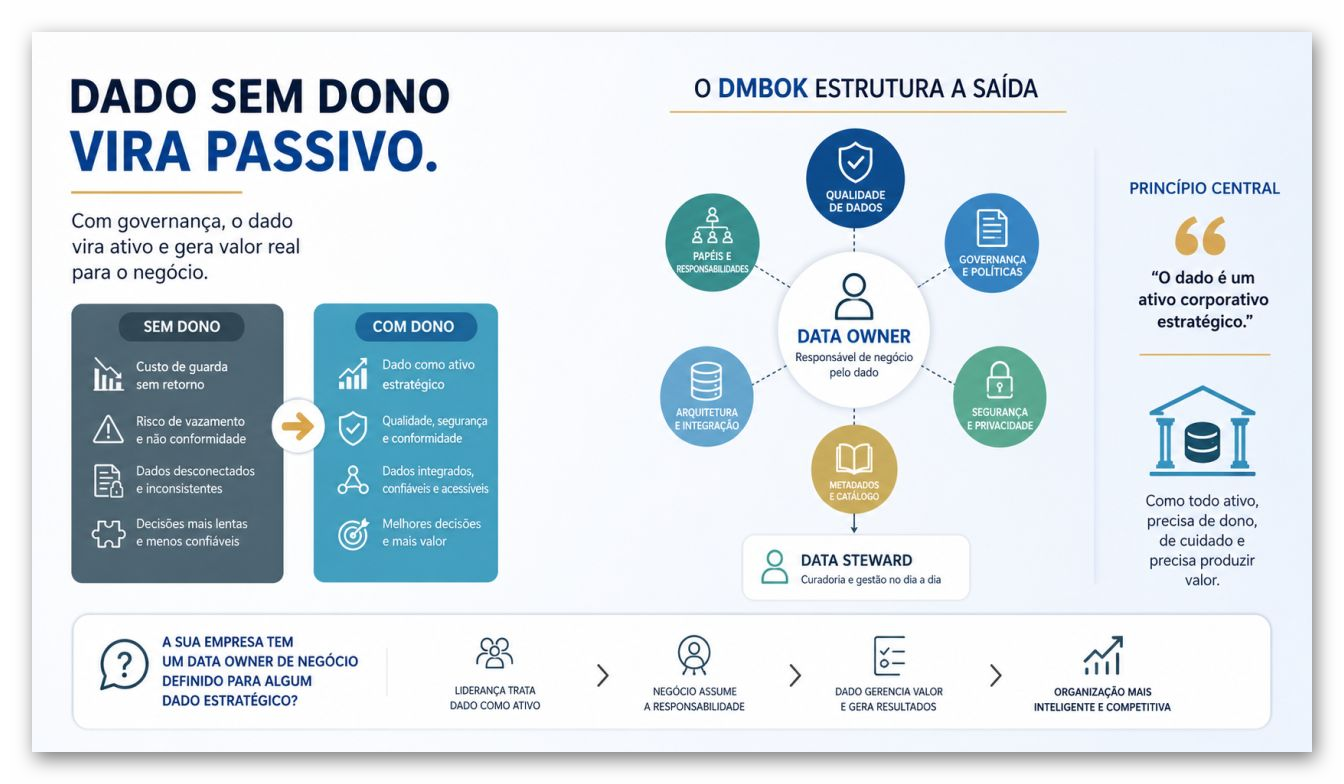
Tons of accumulated data, growing infrastructure and, when the moment to decide arrives, the right information is not available. This is the portrait I most frequently find in organizations regarding artificial intelligence. The inability to use data for better decision-making almost never stems from a problem in the algorithm or the chosen technological platform: it comes from the absence of data governance, the set of practices that defines who is responsible for the data, how it should be managed, and what value it must produce. The DMBOK, 'Data Management Body of Knowledge'—the global reference guide for data management developed by DAMA International, a non-profit and vendor-independent organization present in over 40 countries—exists precisely to structure the exit from this cycle. In this article, I develop what this guide proposes, which roles it defines, and why adoption must necessarily begin with leadership, not IT.
The Recurring Knot in Organizations
I have worked with data governance in medium and large companies for over a decade, and the same problem repeats itself almost methodically. IT knows where the data is stored, understands the systems architecture, and is responsible for the infrastructure supporting storage. The business side, in turn, knows what the data is for, whether it is correct, and how it can generate operational and competitive value. The problem lies exactly in the space between these two areas of knowledge: they almost never meet in a structured way.
When IT and business remain separated in data management, the result is predictable. Data accumulates storage costs without producing results. No one in the business feels responsible for the quality of what is stored because informal responsibility has fallen on IT. And IT, without the business context, has no way of ensuring that the data reflects the company's operational reality.
This knot is what lies behind costly artificial intelligence projects that fail. The problem is almost never in the AI model itself. It is in the material that feeds it. A model trained with inconsistent data, without a defined business context, and without clear quality rules, will reproduce exactly the inconsistency that existed before it. Poor quality data goes in, compromised decisions come out. This is the cycle that data governance, structured by the DMBOK, exists to interrupt.
What is DMBOK and Why It Is the Global Reference in Data Governance
The DMBOK, 'Data Management Body of Knowledge', is the compendium of best practices in data management developed by DAMA International, a non-profit and vendor-independent organization focused on advancing data management as a professional discipline, present in more than 40 countries. Over decades of collective development, the guide has consolidated what the global community of data professionals recognizes as fundamental best practices in managing an asset that is now central to virtually every organizational decision.
The DMBOK organizes data management disciplines into 11 knowledge areas, ranging from governance and architecture to quality, security, metadata, and data integration, with governance positioned at the center of this set as the discipline that guides and sustains all others. Each area defines activities, roles, responsibilities, and practices that organizations should implement, adapted to their context and priorities.
One of the traits that makes the DMBOK a robust reference is precisely what it does not do: it does not prescribe tools, it does not indicate vendors, it does not choose technology. The guide defines what needs to be done and who needs to be responsible, so that any organization can apply it regardless of the technological stack they operate. All of this converges on a central principle explicitly stated by the guide itself: data is a strategic corporate asset that needs an owner, maintenance, and needs to produce value.
Data as a Strategic Asset: What Changes in Practice
Adopting the understanding that data is an asset concretely changes the questions an organization asks about the data it produces and consumes. The dominant question today, in most organizations, is how much it costs to store the data. The correct question, when data is treated as an asset, is different: how much does it cost not to use it, or not to be sure it is correct when a decision needs to be made.
When leadership shifts this perspective, the consequences are practical. Roles must be formally defined. Someone from the business must be accountable for the data, not just IT. Quality criteria must be established and monitored. The data lifecycle, from its creation to its eventual disposal, must be managed deliberately.
None of these changes happen through isolated IT initiatives. All require the business to enter the process as a protagonist, accepting that part of its agenda now includes the active management of the data it uses and produces. Treating data as an asset is not a motivational metaphor: it is a statement with direct operational consequences on how the company uses its information to compete, to fulfill regulatory obligations, and to reduce risks.
Data Owner and Data Steward: The Roles That Move Data Management Away From IT
To operationalize the understanding of data as an asset, the DMBOK defines two central roles that must exist in any data governance program: the 'data owner' and the 'data steward'.
The 'data owner' is the business lead responsible for the data. It is the person or area accountable for the definition of the data, its correct use, its relevance to business processes, and the value it should produce. It is not a technical role. It is a business role with formal responsibility over an organizational asset, analogous to what a financial manager has over a budget line. When this role is not defined, the data remains without a formal owner, and data without a business owner becomes a liability.
The 'data steward' is responsible for the day-to-day data curation, ensuring that data is correctly recorded in systems, that quality criteria are applied, and that the rules established by the 'data owner' are followed in operations. It is the link between the strategic definition of the data and its concrete existence in the company's platforms and processes.
These two roles exist so that data management moves out of IT, where it has been relegated for decades, and reaches where the data truly matters: in the business operation that uses it to make decisions and identify opportunities. The absence of either unbalances the program: without a 'data owner', there is no strategic direction; without a 'data steward', direction exists only on paper, without day-to-day execution.
Data Governance as a Prerequisite for Artificial Intelligence
The connection between data governance via DMBOK and the results of artificial intelligence projects is not theoretical. It is the practical reason why so many AI projects end without delivering what they promised, especially in organizations that skipped the governance stage, considering it less urgent than the technology.
An AI project depends on quality data, with a defined business context, that faithfully represents the reality the model needs to learn. When no 'data owner' has been defined for the data feeding the model, no one is accountable for the quality of what goes in. When there is no 'data steward' monitoring the lifecycle of this data, inconsistencies accumulate without a formal correction process.
The result is what I described at the beginning: companies with tons of data and an inability to use them to make better decisions. In this scenario, AI amplifies the problem that already existed in the source data, rather than qualifying the decisions the project intended to improve. Data governance is not a step that can be skipped when an organization decides to invest in artificial intelligence. It is a prerequisite. The quality and reliability of AI depend directly on the maturity with which the organization manages the data that feeds it.
Adopting DMBOK is a Cultural Change, Not a Technical Project
Adopting DMBOK best practices is not an IT decision. It is a leadership decision, and one of the principles explicitly stated by the guide confirms this: effective data management requires leadership commitment. This shift does not result in a project with a defined beginning, middle, and end: it results in a transformation in how the organization understands and manages what is, today, one of its most strategic assets.
This transformation begins when leadership explicitly decides that data is an asset, not an infrastructure cost. From this decision, the consequences follow in a cascade: roles must be formalized, responsibilities must be assigned, processes must be created to ensure quality throughout the data lifecycle, and the business must accept that part of its agenda now includes the active management of the information it produces and uses.
Organizations that do not make this shift accumulate a growing liability. Storage costs for data that never generated value. Risks of security and privacy incidents involving data for which no one can identify an owner. Inability to use available information when a decision needs to be made. And, increasingly, artificial intelligence projects that promised to transform the business and delivered less than expected because the material feeding the transformation was compromised.
Frequently Asked Questions About Data Governance and DMBOK
What is the DMBOK?
The DMBOK, 'Data Management Body of Knowledge', is the global reference guide of best practices in data management developed by DAMA International. It organizes data management disciplines into 11 knowledge areas, with governance at the center, covering everything from architecture and modeling to quality, security, metadata, and data integration. Its central principle is that data is a strategic corporate asset that needs an owner, maintenance, and value generation. DMBOK does not prescribe tools or technologies: it defines what needs to be done and who needs to be responsible, so that any organization can apply it to its context.
What is a data owner?
The data owner, as defined in the DMBOK, is the business lead responsible for a dataset within an organization. This role includes responsibility for defining what the data represents, its correct use in business processes, information relevance and quality, and the value the data should generate. It is a formal business role, not a technical one. Without a defined data owner for each strategic dataset, the data remains without a formal lead and tends to become a cost and risk liability for the organization.
What is a data steward?
The data steward is the professional responsible for daily data curation. According to the DMBOK, the data steward ensures that quality rules are applied, that data is correctly recorded and maintained in systems, and that the definitions established by the data owner are followed in operations. It is the link between the strategic definition of the data and its concrete existence in the organization's platforms and processes. Without this role, the strategic direction defined by the data owner exists only on paper, without daily operational execution.
What is the difference between a data owner and a data steward?
The main difference between a data owner and a data steward lies in the level and type of responsibility. The data owner is strategically responsible for the data: a business role that defines what the data represents, what value it should generate, and how it should be used. The data steward is operationally responsible: ensuring on a day-to-day basis that the data exists and is maintained according to the data owner's definitions. The two roles are complementary, and both are necessary for data governance to function in practice, combining strategic direction with daily execution.
Why do artificial intelligence projects fail because of data?
Artificial intelligence projects fail due to data issues when organizations start projects without established data governance. Without defined data owners, no one is accountable for the quality of the data feeding the model. Without active data stewards, inconsistencies accumulate without a formal correction process. The result is a model trained on data that does not faithfully represent the reality it should learn, compromising the decisions the project intended to qualify. Poor quality data in, compromised decision out: this is the cycle data governance exists to interrupt.
What is DAMA International?
DAMA International, 'Data Management Association', is a non-profit and vendor-independent organization present in over 40 countries, dedicated to advancing data management as a professional discipline. It is responsible for developing and maintaining the DMBOK—the reference guide for data management best practices—and for communities of practice that bring together professionals worldwide. In Brazil, DAMA Brasil represents this community, promoting data management development in the national landscape and aligning Brazilian organizations with global reference frameworks.
How to start data governance in an organization that does not yet practice it?
Starting data governance in an organization with no history in the field requires, above all, an explicit leadership decision to treat data as a strategic asset. From there, initial steps include identifying which data is most critical to the business, defining who the data owners for each priority set will be, and establishing minimum quality criteria for those datasets. The DMBOK offers a complete map of this journey, but the starting point must be simple, focused on the most relevant data, and sustained by senior leadership commitment. Governance initiated without this commitment cannot be sustained.
Governing data means recognizing that the information an organization produces and consumes every day possesses value, carries risk, and demands formal responsibility. When no business professional is held accountable for strategic data, that data continues to exist in systems, consuming resources and accumulating risk, but without generating the potential return. The DMBOK did not invent this problem: it systematized, through decades of collective contribution from data professionals in dozens of countries, the path to solving it. Adopting data governance is not a technical decision. It is a leadership decision regarding what an organization does with what it knows. In this sense, governing data well is, above all, preserving the ability of people and institutions to use the information they produce in the service of fairer, more responsible, and more dignified decisions.