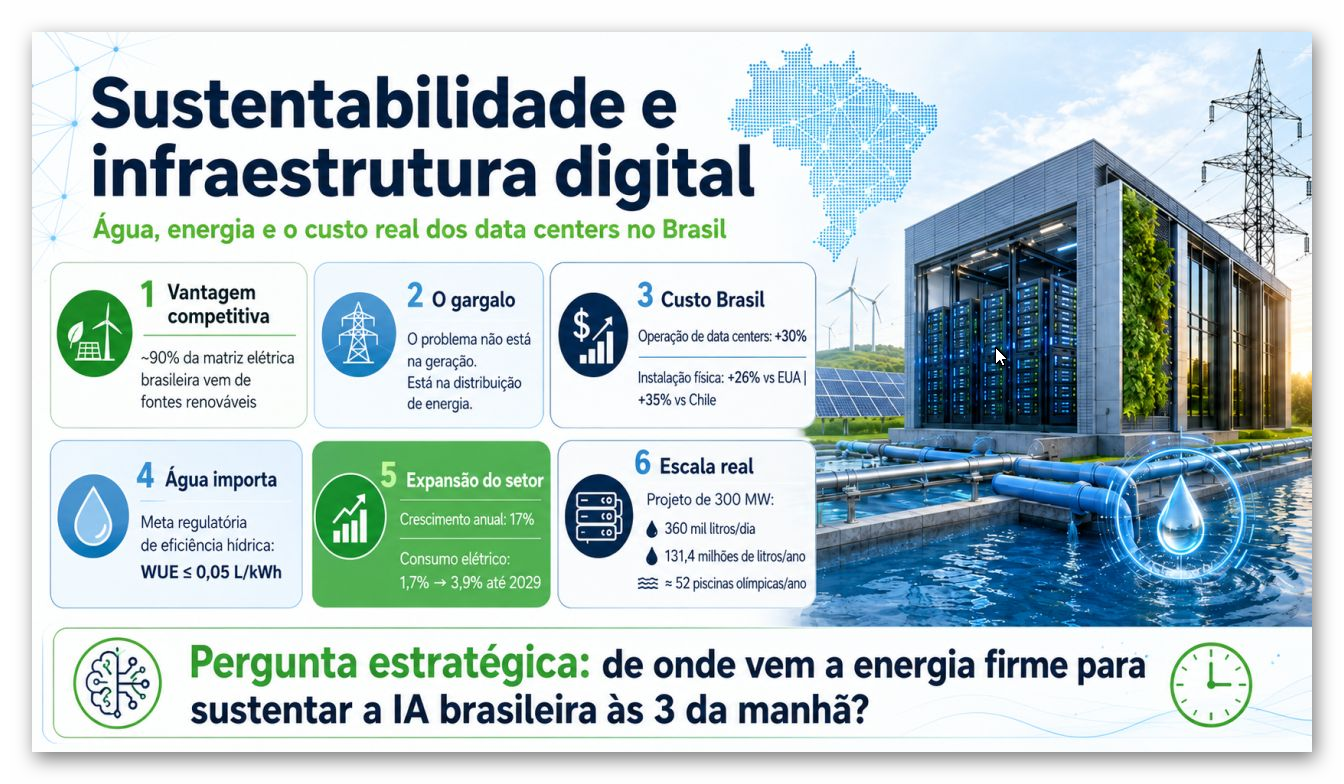
Brazil closes 2024 with nearly 90% of its electricity matrix sourced from renewables, according to the 2025 National Energy Balance published by the Ministry of Mines and Energy. In the global race for artificial intelligence data centers, this represents a real competitive advantage. The paradox is that this advantage does not reach the final price. The operational cost of a data center in Brazil is, on average, 30% higher than in competing markets. Installing physical infrastructure costs 26% more than in the United States and 35% more than in Chile. Yet the sector grows by 17% annually, with the segment's electricity consumption projected to more than double by 2029, rising from 1.7% to 3.9% of the national total. Understanding the gap between generation advantage and final cost obstacles—and between the promise of clean energy and the reality of distribution and water—is what allows for an honest assessment of whether Brazil is prepared to sustain the incoming artificial intelligence wave.
The Real Competitive Advantage and the Accompanying Paradox
The argument in favor of Brazil is solid. An electricity matrix with nearly 90% renewable participation meets a core requirement of major global data center operators, the so-called hyperscalers, who must satisfy decarbonization targets and justify their operations against international environmental commitments. Brazil offers this structurally, not as an exception.
Add to this the geographical position: Northeastern Brazil is the landing point for submarine fiber optic cables connecting the country to other continents, reducing latency—the response time between the processing point and the end user—on transatlantic routes. For global applications seeking a processing hub in the southern hemisphere, the combination of renewable energy and oceanic connectivity is difficult to replicate elsewhere in the region.
The paradox, however, is that this advantage does not translate into competitive costs. And the central cause of this price hike is not the price of electricity. It is the taxation on IT (Information Technology) equipment, which accumulates cascading taxes on every imported component, making the installation of physical infrastructure significantly more expensive in Brazil than in direct competitors. A natural advantage blocked by an artificial obstacle: this is the synthesis of the paradox that REDATA (Special Tax Regime for Data Center Services) seeks to resolve.
The Bottleneck Isn’t in Generation: It’s in Distribution
Even with the advantage in renewable generation, Brazil faces a structural obstacle that does not depend on tax policy: regional distribution and transmission grids are already operating at their limits in several states. As of September 2025, the Ministry of Mines and Energy recorded connection requests totaling 10.2 gigawatts of projected demand until 2029, a volume representing more than 10% of the national average consumption.
Having clean energy available in the annual balance is not the same as having firm energy available the moment servers demand it. A data center is not a factory that scales back production during peak hours or maintenance periods. It operates 24/7, with constant demand and zero tolerance for interruptions. This continuity requires energy to arrive stably, which depends not only on generation but on transmission capacity to the point of consumption.
The distribution bottleneck is, therefore, the obstacle that could neutralize the renewable generation advantage. The country has the energy, but it does not have, in all relevant corridors, the grid to deliver it firmly where demand is growing. Resolving this mismatch is a matter of infrastructure, timelines, and investment, and it cannot be solved solely through tax incentives for server imports.
Taxation as a Hidden Cost: From Historical Weight to Bill 278/2026
The most direct cause of high installation costs in Brazil is not energy prices; it is the taxation of IT equipment. The effective tax burden on electronic components and imported equipment for data centers reached 52%, the result of cascading federal taxes such as Import Tax, IPI (Tax on Industrialized Products), and PIS/Pasep and Cofins contributions.
This rate made physical infrastructure installation costs 26% higher than in the United States and 35% higher than in Chile, two of Brazil's main competitors for hyperscaler projects. Without sector-specific public policies, Brazil was losing projects to other jurisdictions, including those within Latin America.
Bill No. 278/2026, currently awaiting a Senate vote, attempts to reverse this situation by suspending these federal taxes on the acquisition or import of equipment destined for data centers. In practice, the effective rate would drop from 52% to approximately 18%, conditional upon meeting requirements such as contracting 100% clean or renewable energy. It is a structural shift that, if approved, eliminates the primary artificial factor driving up infrastructure costs. The distribution obstacle will persist, but at least installation costs would stop being a self-inflicted competitive disadvantage.
Water: The Critical Input Rarely Mentioned in This Conversation
Energy and taxation dominate the data center debate in Brazil. Water hardly appears, and it needs to. Cooling servers depends on significant volumes of this resource, and the real impact on regional water resources remains an open debate.
The sector argues that modern cooling systems operate in a closed circuit, reusing the same volume continuously. Regulation responded with WUE (Water Usage Effectiveness), a water efficiency index measuring liters consumed per kilowatt-hour of energy used in cooling. The text approved by the Chamber in Bill No. 278/2026 requires companies eligible for REDATA to annually demonstrate a WUE equal to or less than 0.05 liters per kilowatt-hour consumed in cooling.
This regulatory limit, when applied to projects of the scale arriving in Brazil, reveals the magnitude of what is at stake. TikTok's data center in the Pecém Industrial and Port Complex, in Ceará, projects 300 MW of installed capacity in its initial phase. Even with promised air cooling, if it operated at the regulatory limit of 0.05 WUE, it would consume 360,000 liters of water per day—equivalent to 131 million liters per year. These figures demand a serious response regarding regional water management, especially in states that combine high drought incidence with high wind generation potential.
Not Every Digital Load Needs to Be Here: Architecture as a Strategic Decision
There is a technical dimension to this debate that is rarely addressed with the clarity it deserves. Not all digital workloads have the same location requirements. Applications requiring real-time response, such as AI inference in interactive services, financial transactions, and telemedicine, need data centers close to the end user. These are called Edge Data Centers—geographically distributed structures designed to reduce the physical distance between processing and the point of consumption, thereby reducing latency.
AI model training is different. This stage requires massive processing over long periods but does not depend on low latency. A model can be trained anywhere infrastructure is stable and costs are viable. It is inference that needs to be close. Separating these two workloads is an architectural choice with direct impact on cost, sovereignty, and sustainability.
This distinction matters for public policy. Encouraging the installation of any type of data center in Brazil is different from specifically incentivizing those that serve the processing of Brazilian data or the training of models with national strategic interest. Deciding which load stays where is, in Consuelo Rodrigues' analysis, a governance choice that must happen before the infrastructure, not after.
The Scale of What’s Coming and the Question Not Yet Asked
A single project illustrates the scale of what is underway. TikTok's data center at the Pecém Complex in Caucaia, Ceará, projects 300 megawatts of installed electrical capacity in its initial phase, operated by Omnia, Pátria Investimentos' data center platform, with ByteDance as the tenant. For comparison, the total installed data center capacity in Brazil is currently around 700 to 800 megawatts. A single project represents nearly one-third of the country's entire existing capacity.
The data center sector in Brazil is growing at 17% per year, and the segment's electricity consumption is expected to rise from 1.7% to 3.9% of the national total by 2029. These numbers pose a question that Brazil is not yet asking with the seriousness it deserves: where will the firm energy come from to sustain artificial intelligence at three in the morning? Not the energy that exists on the annual balance sheet, but the energy that reaches the server at that specific second, continuously, without interruption, regardless of regional grid conditions.
This is a question of infrastructure. It is a question of regulation. It is a question of long-term energy planning. And it is also a question of sovereignty, because the answer defines whether Brazil will be a processing hub with the capacity to guarantee continuity or merely an attractive location until the infrastructure collapses.
Frequently Asked Questions about Data Centers, Energy, and Digital Infrastructure in Brazil
Q: What is WUE and why does it matter for data centers?
WUE (Water Usage Effectiveness) is a water efficiency index that measures how many liters of water are consumed per kilowatt-hour of energy used to cool a data center. WUE matters because server cooling is one of the primary consumers of water in this type of infrastructure. Bill No. 278/2026, which establishes REDATA, requires enabled companies to annually prove a WUE of 0.05 liters per kilowatt-hour or less—a limit that translates into significant consumption when applied to large-scale projects.
Q: What are Edge Data Centers and why does their location matter?
Edge Data Centers are geographically distributed processing structures designed to reduce the physical distance between processing and the end user, minimizing latency (response time). Edge Data Centers are necessary for applications requiring real-time response, such as AI inference in interactive services, financial transactions, and telemedicine. Unlike model training, which can occur wherever infrastructure is cheapest and most stable, inference must be close to the user. Deciding which load goes to which type of data center is an architectural choice with direct impacts on cost, sovereignty, and sustainability.
Q: Why is installing a data center in Brazil more expensive than in Chile or the United States?
Installing a data center in Brazil costs, on average, 26% more than in the United States and 35% more than in Chile. The central cause is not electricity prices, which are structurally competitive in Brazil, but rather the taxation of IT equipment, which accumulates cascading taxes on imported components. The effective tax burden reached 52% before REDATA. Bill No. 278/2026, awaiting Senate approval, seeks to reduce this rate to approximately 18%, conditional on environmental and economic requirements.
Q: What does Bill 278/2026 change regarding tax costs for data centers in Brazil?
Bill No. 278/2026, which establishes REDATA (Special Tax Regime for Data Center Services), suspends the incidence of federal taxes—including Import Tax, IPI, PIS/Pasep, and Cofins—on the acquisition or import of ICT (Information and Communication Technology) equipment intended for data centers. In practice, it reduces the effective tax burden from 52% to around 18%, conditional on contracting 100% clean or renewable energy and other economic counter-provisions.
Q: Does Brazil have enough energy to sustain data center growth?
Brazil has abundant renewable generation, with nearly 90% of the electrical matrix coming from renewable sources, representing a structural advantage. The challenge lies not in generation but in distribution. Regional transmission grids are already at their limits in several states, and the connection demand from projected data centers far exceeds the current capacity to deliver firm energy—energy that must reach the server continuously and without interruption. Solving this bottleneck requires long-term investment in transmission infrastructure.
Q: What is the scale of the TikTok data center project in Ceará?
TikTok's data center at the Pecém Industrial and Port Complex in Caucaia, Ceará, projects 300 megawatts of installed electrical capacity in its initial phase, operated by Omnia, Pátria Investimentos' data center platform, with ByteDance as a long-term tenant. This volume is equivalent to the consumption of a city with approximately 2.4 million inhabitants and represents roughly one-third of Brazil's current total installed data center capacity, estimated at 700 to 800 megawatts. Construction began in January 2026, with operations scheduled to start in the third quarter of 2027.
Brazil's competitive advantage in the global AI data center race is real: a nearly 90% renewable matrix, strategic geographic position, and growing digital demand that justifies investment. What remains unresolved is the entire chain sustaining this advantage. Taxation is beginning to be addressed by Bill 278/2026. Distribution requires infrastructure projects that take years. Water demands regional planning that rarely appears on decision-making agendas. And the architecture of which workload stays where requires a governance choice that must precede the infrastructure. Governing the arrival of AI data centers in Brazil is not the market's job. It is the job of the State, of regulation, and of professionals who understand that digital infrastructure is critical infrastructure: it cannot be improvised, it cannot be recovered quickly when it fails, and it does not automatically protect the rights of those who rely on it.